
- Introduction to Happy World Parrot Day and its significance in promoting parrot conservation.
- Detailed profiles of the Macaws and Thick-Billed Parrots highlighted in the article, including their characteristics and histories.
- Conservation challenges facing parrots and the efforts being made to protect them.
- The role of zoos and zookeepers in parrot conservation and education.
- Encouragement for public involvement in parrot conservation initiatives.
Parrots, with their vibrant colors and engaging personalities, captivate anyone lucky enough to encounter them. Celebrated globally, Happy World Parrot Day aims to highlight these remarkable birds‘ conservation needs. This day is an opportunity to educate the public about the threats parrots face and the efforts to mitigate those dangers.
Focusing on our featured residents—macaws and Thick-Billed Parrots—the article aims to provide insights into their lives, characteristics, and the conservation efforts aimed at protecting them. Our descriptions will extend to Rio, Mac, and Festus, our resident macaws, and the Thick-Billed Parrot couple, Juniper and Junior, who invite a deeper understanding of parrot conservation.
Profiles of Macaws
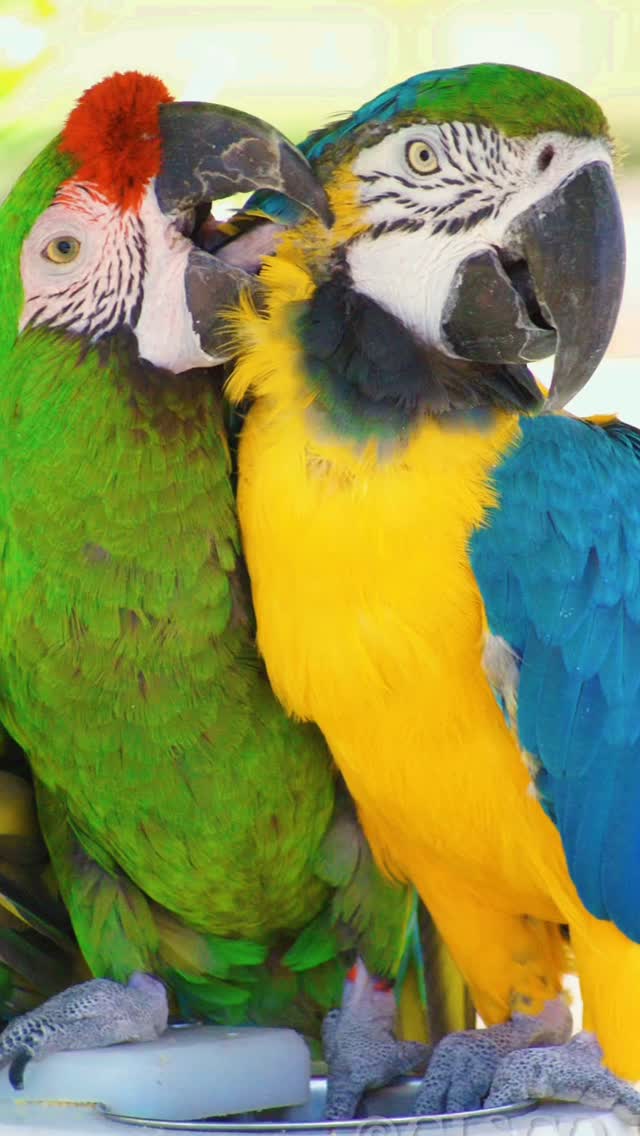
Macaws are stellar representatives of parrot diversity. Known for their spectacular plumage and intelligence, they draw attention with their antics and social behaviors. Our zoo’s beloved macaws include Rio, a 35-year-old Blue & Yellow Macaw, donated in 1992, and Mac, a 29-year-old, arriving in 1997. Their bond is exemplary of the strong social ties macaws form, often relying on mutual grooming and close contact.
Festus, a Military Macaw, diversifies this group with his slightly different coloration and spirited antics. With a lifespan extending beyond 50 years, these birds require dedicated care. Military Macaws, like Festus, are less common, categorized as vulnerable due to habitat loss and poaching.
Histories of Thick-Billed Parrots
Unlike most parrot species, the Thick-Billed Parrot is native to North America, with habitats ranging into the southwestern United States. Juniper, an 18-year-old female, and Junior, her 17-year-old mate, represent an iconic yet endangered species, largely due to deforestation.
Their journey at the zoo has been challenging, as evidenced by three unsuccessful clutches. However, undeterred, they are entering another nesting season with hopeful prospects. Conservationists are keen to see these birds thrive, using breeding programs to support population recovery.
Conservation Challenges
Parrot populations around the globe are under pressure from habitat destruction, illegal pet trade, and climate change. Forests, crucial for nesting and food sources, are rapidly disappearing, leaving many species with insufficient resources. The illegal trade further exacerbates these challenges, with many parrots captured and sold, often illegally, for their beauty and sociable nature.
Efforts to counteract these trends are vital. Programs aimed at habitat preservation, law enforcement against poaching, and captive breeding have shown promise. Education campaigns play a significant role in reducing demand for wild-caught parrots.
The Role of Zoos
Zoos are pivotal in parrot conservation, functioning as sanctuaries and educational centers. They offer safe habitats where birds like Rio, Mac, Festus, Juniper, and Junior can thrive under expert care. Such institutions conduct breeding programs aimed at population enhancement and often participate in research projects contributing to broader conservation strategies.
Zookeepers are essential, forming bonds with these creatures, understanding their unique behaviors, and ensuring their well-being. With efforts going beyond daily care, these professionals participate in global conservation networks, exchanging knowledge and resources.
Public Involvement
Public involvement is crucial to advancing parrot conservation. Informed visitors can advocate for policy changes, contribute to conservation funds, and practice sustainable environmental behaviors. Supporting legislation and conservation organizations offers direct means to impact parrot survival positively.
Volunteering at local wildlife centers or participating in citizen science projects are excellent ways to contribute. Education and awareness can inspire future generations to continue safeguarding these incredible birds.
In celebrating Happy World Parrot Day, we honor these magnificent creatures and renew our commitment to their protection. Whether through conservation efforts, education, or simple appreciation, each action can help secure a brighter future for macaws, Thick-Billed Parrots, and other avian wonders. Engaging with these initiatives is not just pivotal but inspiring—a call to preserve our planet’s vibrant biodiversity.
*****
Source Description
🦜❤️ Happy World Parrot Day to our beautiful Macaws and Thick-Billed Parrots!!
💚 Rio, Mac, and Festus are the BFFs you first encounter when you walk into the zoo.
– Rio is a 35 yr. old Blue & Yellow male Macaw. He was donated to the zoo in 1992.
– Mac is a 29 yr. old Blue & Yellow male Macaw. He was donated to the zoo in 1997.
– Festus is a 36 yr. old Military male Macaw. He was donated to the zoo in 1993.
🩷 Juniper and Junior are the Thick-Billed Parrot couple.
Juniper is our 18 yr. old female and Junior is her 17 yr. old mate.
They have had 3 unsuccessful clutches. They are now going into Nesting Season. We hope that their fourth clutch will prove fruitful.
🙏👏 As always, we are always grateful to have such wonderful zookeepers that tend to our animals and the entire zoo crew that maintains both the zoo grounds and the facilities that provide shelter to our animals!
