
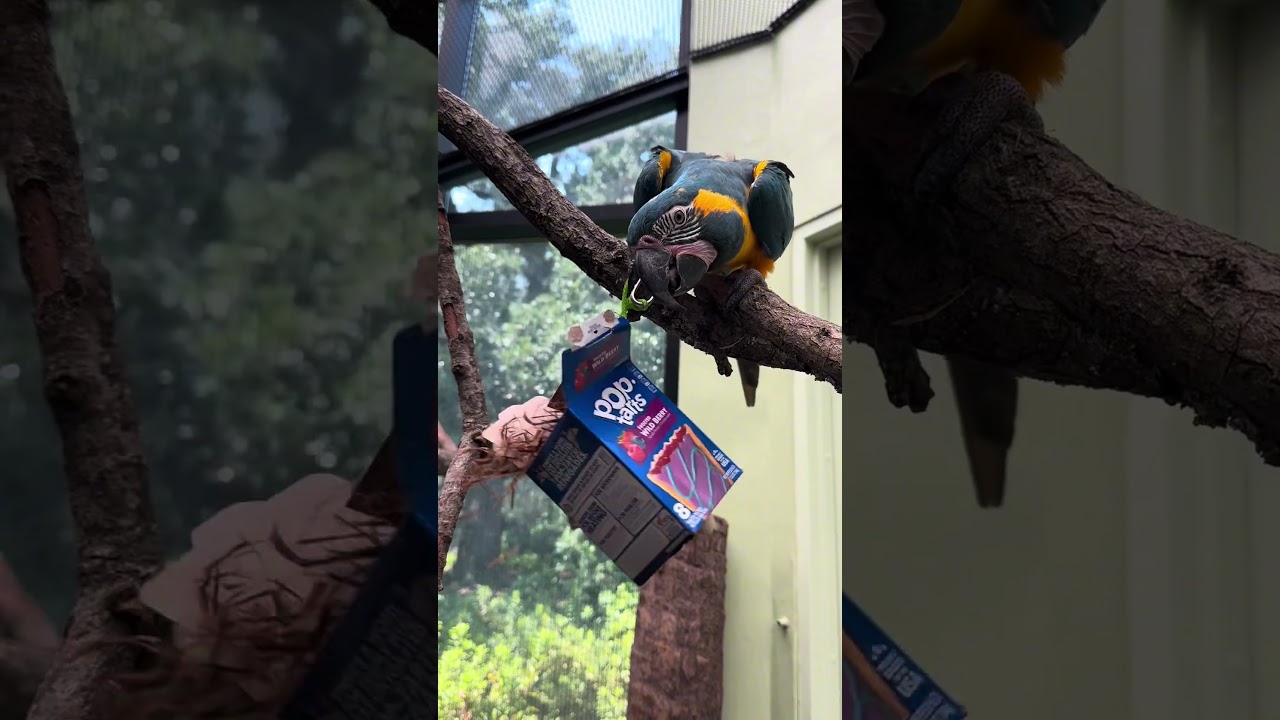
- The importance of enrichment activities for hyacinth macaws, focusing on cognitive and behavioral stimulation.
- The specific enrichment techniques used for Banana, the hyacinth macaw, and their impact on her well-being.
- An exploration of the role of enrichment in captive animal management and how it contributes to conservation efforts.
- The integration of scientific understanding and practical applications in zoo management to enhance animal care.
- Insights into the natural behaviors of hyacinth macaws and how enrichment mimics these in a controlled environment.
Enrichment activities are vital for maintaining the mental and physical health of captive animals, particularly for intelligent species such as the hyacinth macaw. Known for their vibrant blue plumage and large size, hyacinth macaws are the largest flying parrot species. Their intelligence is comparable to that of a toddler, making cognitive and behavioral stimulation essential for preventing boredom and encouraging natural behaviors.
The introduction of enrichment activities like those employed for Banana, the hyacinth macaw, is a cornerstone of effective animal care in captivity. These activities are tailored to stimulate Banana’s senses and intellect, keeping her engaged and healthy. For example, puzzle feeders encourage problem-solving and replicate foraging behavior seen in the wild. Training sessions incorporate both mental challenges and physical activity, fostering a bond between the bird and her keepers while ensuring physical fitness.
The concept of enrichment extends beyond just keeping animals entertained. In the context of zoo management, it plays a critical role in mental health and overall well-being. By addressing the needs of animals through enriched environments, zoos contribute significantly to conservation efforts. For animals like hyacinth macaws, efforts to mimic natural behaviors and habitats in captivity support species preservation by maintaining genetic diversity and breeding success.
Modern zoo management employs a sophisticated understanding of animal behavior and welfare, integrating scientific research and observation into daily care routines. Enrichment activities are carefully designed based on an animal’s species-specific needs and natural history. This level of care leverages scientific knowledge to enhance animal welfare. For Banana, this means activities that challenge her intellect and mimic her natural diet and environmental interactions, providing a holistic approach to her care.
Understanding the natural behaviors of hyacinth macaws provides key insights into designing effective enrichment programs. In the wild, these birds are known for their complex social structures and strong bonds. They engage in playful activities, utilize tools, and exhibit significant problem-solving skills. Enrichment activities aim to replicate these behaviors, offering items to manipulate and encouraging social interactions with other birds. By doing so, zoos not only enhance individual well-being but also contribute to the broader goals of species conservation and public education.
In summary, the enrichment activities designed for Banana underscore the importance of incorporating behavioral science into zoo management. These initiatives enhance the quality of life for creatures like the hyacinth macaw and play a crucial role in global conservation efforts. Through enrichment, zoos provide environments that promote natural behaviors, aiding in the preservation of species and fostering greater understanding and appreciation for wildlife.
*****
Source Description
#audubonzoo #macaw #macawsoftiktok #enrichment
