
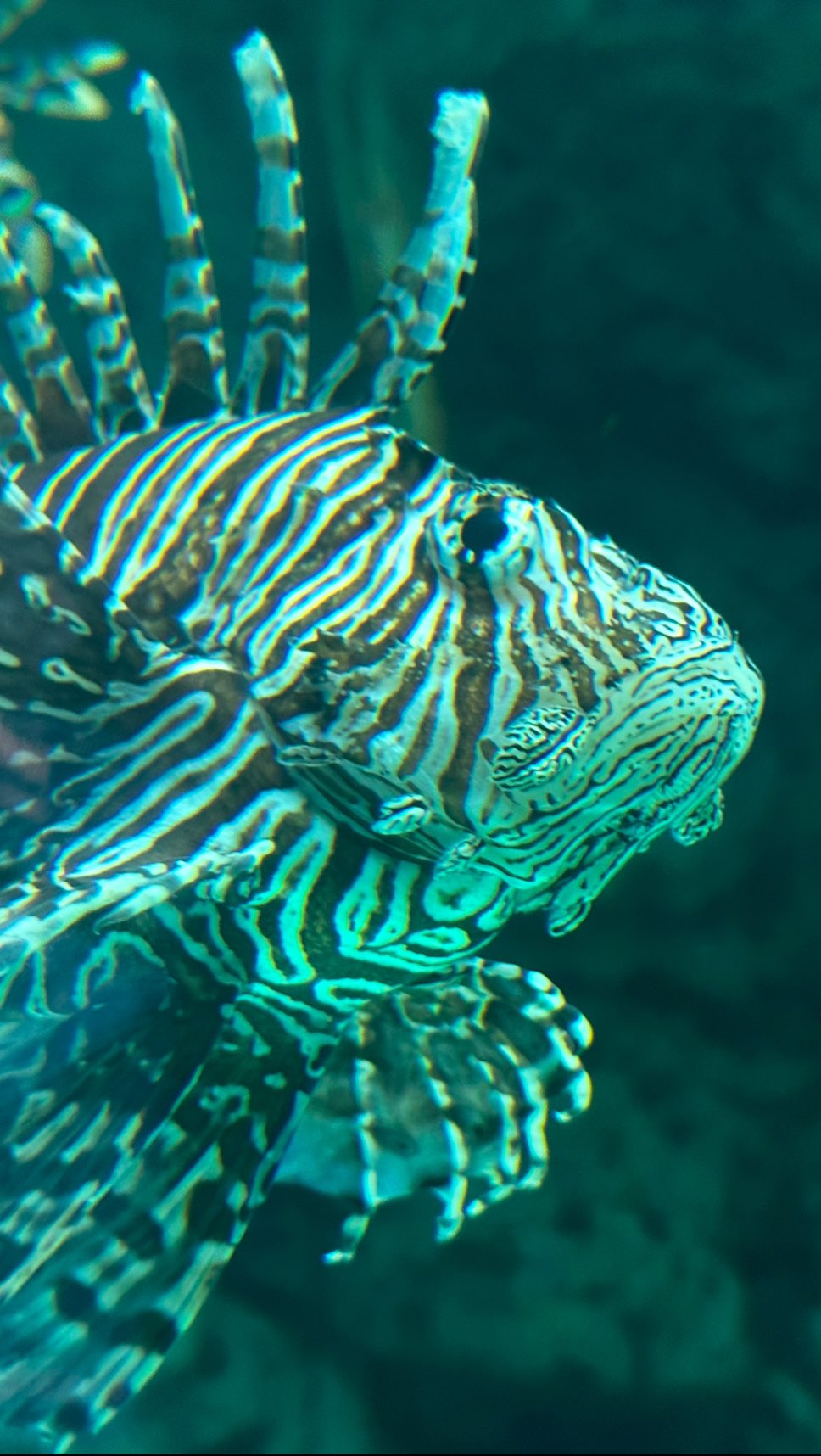
- Lionfish are visually striking but ecologically harmful invasive predators.
- Their venomous spines pose a risk to people, while their population impacts target reef fish and coral systems.
- Invasive lionfish disrupt food webs by consuming juvenile reef species and reducing herbivore pressure on algae.
- Aquarium education, public awareness, and responsible action play important roles in conservation.
- Understanding and managing invasive species helps protect coral reef health and biodiversity.
Beautiful but dangerous is an accurate description of the lionfish. This fish draws attention wherever it appears. Its striped body, fanlike fins, and graceful movement make it popular in aquariums and striking in photographs. Yet the same animal has become one of the most serious invasive predators in Atlantic coral reef ecosystems. The lionfish shows how appearance can mislead. A species may look ornamental and still cause measurable ecological harm.
National Invasive Species Awareness Week gives museums, aquariums, zoos, land managers, and conservation educators a chance to explain that danger clearly. Invasive species are not simply nonnative species. Many introduced organisms do little harm. An invasive species is one that spreads aggressively and causes ecological, economic, or public health damage. The lionfish fits that definition in many parts of the western Atlantic, the Caribbean, and the Gulf of Mexico. It threatens reef fish communities, changes food web structure, and contributes to reef decline.
The lionfish belongs to the family Scorpaenidae, the scorpionfishes. Two species are especially important in the invasion: Pterois volitans and Pterois miles. Both are native to the Indo-Pacific region. Their bodies carry long venomous spines on the dorsal, pelvic, and anal fins. These spines are not used for hunting. They are a defense system. If a person is punctured, the result can be intense pain, swelling, redness, nausea, and in some cases more serious systemic effects. Fatal cases are rare, but medical attention is recommended after a sting.
The venom is protein-based and heat-labile, which means hot water can reduce pain by helping denature some venom components. First aid still matters. The injured area should be cleaned, the person should be monitored, and medical care should be sought if symptoms worsen. This public safety issue is real, but it is only part of the story. The greater concern is the fish’s ecological impact. A lionfish can be handled safely only with proper training and equipment, and only by authorized personnel or trained divers in management programs.
Lionfish are effective predators because of how they hunt. They do not chase prey over long distances. Instead, they hover, fan their pectoral fins, and use quick suction feeding to engulf small fish and crustaceans. They feed on a wide range of species. Juvenile reef fish are especially vulnerable because they are abundant, small, and often less experienced. Lionfish consume large numbers of these juveniles, including species that play important ecological roles. Many of the prey items are native fish that help maintain reef function.
This feeding behavior has direct consequences. Reef fish communities can lose density and diversity. When herbivorous fish decline, algae can grow more rapidly across coral surfaces. That matters because algae competes with coral for space, light, and access to the reef substrate. Coral polyps need room to settle and grow. If algae overtake available surfaces, coral recruitment drops. Reefs with fewer corals are less able to support fish, absorb wave energy, and recover from bleaching, storms, and other stressors. Lionfish are not the only threat to coral reefs, but they add pressure to systems already under strain.
The life history of the lionfish helps explain its spread. In invaded waters, the fish reproduces quickly. Females can release large numbers of buoyant egg masses throughout much of the year in warm climates. Those eggs drift with currents and disperse over wide areas. Young lionfish grow quickly and reach reproductive size in a short time. The species also tolerates a wide range of depths and habitats, from shallow reefs and mangroves to deeper mesophotic zones. This flexibility makes control difficult. It also gives the fish access to places where many predators and removal efforts are limited.
Natural predators in the invaded range are few. In its native environment, lionfish are part of a larger ecological network with competitors, parasites, and predators that help limit population growth. In the western Atlantic, those checks are weak. Some native predators may occasionally consume lionfish, but not at a level that controls the invasion. This is one reason invasive species can become dominant outside their native range. They leave behind the ecological constraints that shaped their behavior and abundance.
The aquarium trade played a role in the lionfish introduction. Escapes or releases from captivity likely seeded the invasion in the Atlantic. Once established, the species spread rapidly. This history matters because it shows how human actions can move organisms far from their native ranges. It also shows why prevention is one of the most effective tools in invasive species management. A fish that is attractive in a display tank can become a major conservation problem if released into a suitable environment.
At aquariums, the lionfish can serve as a strong educational species. A live display gives visitors a close look at anatomy, coloration, and behavior. It also creates an opening to discuss invasive species biology, responsible pet ownership, and reef conservation. Public education can change behavior. People who learn why species should never be released into local waterways are more likely to dispose of pets responsibly. They are also more likely to support habitat protection, invasive species monitoring, and reef stewardship.
The Blue Hole exhibit offers exactly this kind of educational value. Visitors can observe the fish at a safe distance and learn about both its beauty and its ecological risk. That combination is important. Conservation education works best when it is concrete. A real animal in a real exhibit gives context that signs alone cannot provide. Guests can see the dramatic fins, the bold striping, and the controlled movements that make the lionfish so recognizable. At the same time, they can hear why this same fish has become a management concern across tropical western Atlantic waters.
Management of lionfish requires persistent effort. Divers and trained crews often remove them using spears or specialized containment methods. In some areas, targeted harvest supports local food markets and helps reduce densities. That approach can work best when paired with regular monitoring. The goal is not a one-time cleanup. The goal is ongoing pressure that lowers numbers and protects sensitive reef sites. Research has shown that repeated removal can improve local reef fish abundance in some locations, especially when efforts are sustained.
Community participation also matters. Recreational divers, anglers, scientists, and coastal residents all contribute to detection and reporting. Early reporting of new infestations can help managers respond before populations expand. Education campaigns should explain that releasing aquarium animals is never acceptable. They should also make clear that invasive species management is a long-term conservation task, not a short campaign. The lionfish is a strong example because its impacts are visible, its biology is well studied, and its spread has been documented across many regions.
Coral reef ecosystems depend on balance. Herbivorous fish graze algae. Small predators regulate prey species. Corals build structure over time. When one aggressive predator enters the system and removes too many juvenile fish, the balance shifts. That shift can ripple through the food web. Fewer small fish can mean fewer larger fish later. Less grazing can mean more algae. More algae can mean less coral recruitment. The result is a weaker reef. The lionfish does not act alone, but it can accelerate decline in places where other stressors already exist.
The economic effects are also important. Healthy reefs support fisheries, tourism, shoreline protection, and local livelihoods. When reef condition declines, those services decline too. Managers therefore treat lionfish as both an ecological and a resource issue. They are not simply a striking exhibit fish. They are a case study in how invasive species alter systems that people depend on.
The lionfish also teaches a broader conservation lesson. Appearance is not a measure of ecological value. Some of the most visually appealing animals can still harm native habitats if moved outside their natural range. Conservation work depends on looking past first impressions and focusing on function, origin, and ecological relationships. That is why National Invasive Species Awareness Week is useful. It brings attention to the science behind introductions, spread, and control.
Visitors who see a lionfish up close can leave with more than a photo. They can leave with a better understanding of coral reef ecology, invasive species pathways, and the role of public action in conservation. They can also recognize that prevention is powerful. Never release pets. Support local removal programs. Respect wildlife regulations. Share accurate information. Those actions help reduce the pressure on reefs and other ecosystems.
The lionfish remains a vivid example of how an animal can be beautiful and dangerous at the same time. Its venomous spines defend it from harm. Its feeding habits, reproductive output, and rapid spread make it a serious invasive predator. Its presence in aquariums can support education, but its presence in the wild can damage reef communities and coral structure. A close look at the lionfish reveals an important truth in conservation biology: attractive species can still be highly disruptive when introduced into the wrong habitat.
*****
Source Description
Beautiful but dangerous! 🦁🐟✨ We’re highlighting National Invasive Species Awareness Week by taking a closer look at an invasive species found right here at the aquarium: the lionfish! Its venomous spines can sting humans, but its real danger lies in its role as an invasive species—depleting fish populations, disrupting food webs, and damaging coral reefs. Lionfish overconsume important reef species and allow algae to overtake corals, weakening these ecosystems.
Have you seen a lionfish up close? 👀 Swing by our Blue Hole exhibit to see one for yourself! 💙
