
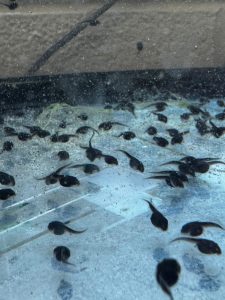
Summary of Restoring the Puerto Rican Crested Toad: Tadpoles Raised at Potter Park Zoo Join Global Effort:
The Puerto Rican Crested Toad Conservancy (PRCTC) operates the longest-running amphibian reintroduction program, working to conserve the endangered Puerto Rican crested toad (Peltophryne lemur). Recently, over 300 tadpoles from Potter Park Zoo were sent to Puerto Rico for release, marking a significant step in their conservation efforts, which involve collaboration from 17 institutions and the release of over 889,000 tadpoles since the program’s inception.
The tadpoles, packed carefully for transport, will be acclimated in monitored ponds upon arrival. The species faces threats such as habitat loss, invasive species, and rising sea levels. Since its inception in 1984, the program has evolved into a nonprofit entity aiming to bolster conservation efforts, including a new research center in Puerto Rico. Supporting this initiative helps in preserving not just the Puerto Rican crested toad but also other endangered species.
- The critical state of the Puerto Rican crested toad and its conservation status
- The reintroduction program led by the Puerto Rican Crested Toad Conservancy
- Collaborative efforts among zoos and conservation organizations for breeding and releasing tadpoles
- The specific challenges faced by the species and habitat
- The role of public support and zoo engagement in conservation efforts
The Puerto Rican crested toad (Peltophryne lemur) is currently categorized as endangered by the IUCN Red List and faces significant threats to its survival. As the only native toad species on the island, its plight is a point of concern for conservationists. Habitat loss, primarily due to urban development, agricultural expansion, and the introduction of invasive species, has drastically impacted its population. Notably, invasive species like the marine toad and the Cuban tree frog have outcompeted the crested toad for resources. Moreover, rising sea levels, exacerbated by climate change, further threaten its natural environments, limiting the areas where these toads can thrive.
In addressing these challenges, the Puerto Rican Crested Toad Conservancy (PRCTC) has established the longest continuously running reintroduction program for any amphibian species. This initiative exemplifies a concerted effort to conserve the species through scientific research and community engagement. Recognizing that successful reintroduction requires more than simply releasing animals, the PRCTC focuses on breeding, monitoring, and evaluating the needs of the population both in captivity and in the wild.
Collaboration plays a crucial role in the ongoing efforts to save the Puerto Rican crested toad. The PRCTC partners with various institutions and zoos across the United States and Puerto Rico. These organizations collectively fund the breeding and reintroduction processes while sharing valuable insights and strategies. Approximately 17 institutions are currently engaged in these efforts, having released over 889,000 tadpoles into Puerto Rico since the program’s inception. Each release is meticulously coordinated to ensure that the tadpoles share similar sizes and ages, simplifying their adaptation to the wild.
Breeding practices in captivity are highly specific and strictly regulated. Breeding toads are kept in isolation to prevent disease transmission and protect both captive and wild populations. Hormonal treatments are often employed to synchronize breeding cycles among the toads, enabling a more efficient process for hatching tadpoles. Once the tadpoles are prepared for release, they undergo careful packing for transport. At Potter Park Zoo, zookeepers use modified fish transport techniques, including oxygen infusion and specialized filters within bags before dispatching the tadpoles through reliable shipping avenues.
The adaptation phase upon arrival in Puerto Rico is another essential facet of the reintroduction program. The tadpoles are placed in artificial ponds where their acclimatization can be carefully monitored. Regulatory bodies such as the U.S. Fish and Wildlife Service (USFWS) and the Puerto Rico Department of Natural and Environmental Resources (PRDNER) supervise these sites. This oversight aims to prepare them for their eventual metamorphosis into adult toads.
Currently, there are four primary reintroduction sites in Puerto Rico. These locations have been selected based on historical habitat suitability. They include three sites in the northern part of the island—El Tallonal, Río Encantado, and La Esperanza—and one in the south, at Los Conventos, Guayanilla. The ongoing work has been critical in maintaining genetic diversity in the metapopulations existing in the wild, which includes some of the last known natural populations.
The Puerto Rican crested toad’s history with conservation initiatives dates back to 1984 when it became the first amphibian species included in the Species Survival Plan (SSP) under the Association of Zoos and Aquariums. In 2021, this program was formally restructured and renamed the Puerto Rican Crested Toad Conservancy, reflecting its evolution toward a more comprehensive organizational framework for amphibious conservation.
The establishment of a new conservation research center in Puerto Rico underscores a commitment to long-term preservation. This center will facilitate targeted research efforts and the mass production of offspring, aiding future population expansion. Such strategies are vital for quickly establishing new populations, vital for ensuring the survival of the species in the face of ongoing environmental changes.
Public engagement and support are indispensable components of the conservation strategy. Institutions like Potter Park Zoo actively encourage community involvement through educational programs and membership opportunities. By participating in these initiatives, the public contributes directly to efforts that support the Puerto Rican crested toad. Every visit, membership, and philanthropic donation propels productive work, allowing for greater conservation initiatives not just locally, but globally.
Areas of focus extend beyond direct breeding and release; changes in land use and public awareness are crucial for sustainable conservation. The local communities’ understanding of the significance of biodiversity and habitat preservation will profoundly influence the outcomes of conservation programs. Schools and organizations often work with conservationists to spread the message regarding the importance of protecting species like the Puerto Rican crested toad.
The plight of the Puerto Rican crested toad represents a broader narrative about the fragility of amphibian populations worldwide. Their sensitivity to environmental changes makes them indicators of ecosystem health. Therefore, restoring their populations can yield insights into the overall conditions of their habitats. Each tadpole released back into Puerto Rico offers a glimpse of hope for the future, not only for the species itself but also for the ecosystems they inhabit.
The collaborative reintroduction program aims to continuously adapt and refine methods based on empirical evidence drawn from ongoing research. Each experiment and observation informs approaches for future releases, laying the groundwork for new standards in amphibian conservation.
In summary, the conservation of the Puerto Rican crested toad involves a multifaceted approach. It includes breeding programs, habitat restoration, community education, and collaborative frameworks. Together, these components build an integrated strategy designed to revive and sustain the population of this remarkable toad species in the wild, ensuring its future for generations to come.
🐸 Puerto Rican Crested Toad at a Glance
- Scientific name: Peltophryne lemur
- Common name: Puerto Rican crested toad (PRCT)
- Status: Endangered (IUCN), Threatened (USFWS), Endangered (PRDNER)
- Threats: Habitat loss and fragmentation, invasive species (marine toads, Cuban tree frogs), rising sea levels
- Conservation firsts: First amphibian Species Survival Plan (SSP), 1984
- Tadpoles released: Over 889,000 reintroduced to Puerto Rico since the program began
- Fun fact: Tadpoles are shipped via FedEx to Puerto Rico for release into monitored ponds.
