
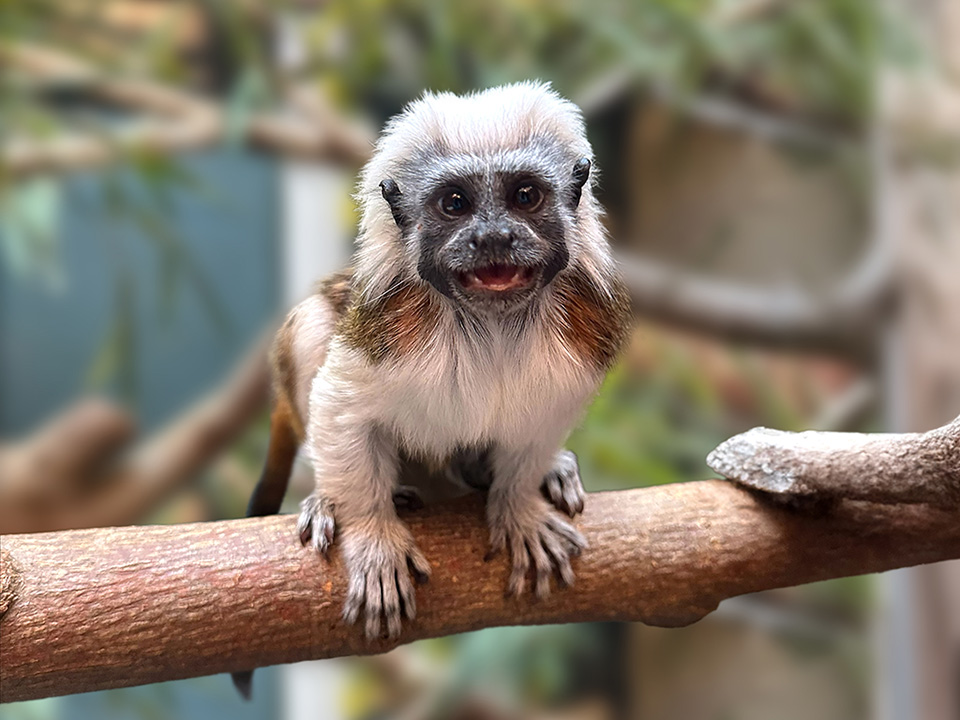
- Pepita’s early life shows why young primates should never be raised as pets.
- Cotton-top tamarins are highly social animals that depend on stable family groups and daily social contact.
- Zoo staff used veterinary care, nutrition, and behavioral management to help Pepita recover from malnutrition and adapt safely.
- Pairing Pepita with an older female tamarin, Caqueta, reflects standard animal welfare practice for social primates.
- The Riverbanks Conservation Outpost helps teach the public about primate conservation, responsible ownership, and the risks of the pet trade.
Pepita the cotton-top tamarin’s story offers a clear lesson in primate care, animal welfare, and conservation. Before she was rescued from an unsafe living situation, Pepita was raised with the intention of being kept as a pet. That start placed her at risk from the beginning. Cotton-top tamarins are wild primates, and wild primates do not adapt well to life as household animals. They need social partners, complex surroundings, expert nutrition, and consistent veterinary oversight. They also need lives that match their biology. For a species like the cotton-top tamarin, that means living with other tamarins in a stable group, not in isolation or as an ornament for human amusement.
Pepita arrived at Riverbanks Zoo and Garden when she was only 2 months old. At that age, a cotton-top tamarin is still dependent on milk, warmth, social contact, and close care. She was malnourished. Malnutrition in infant primates can affect growth, immune function, bone development, and brain development. Young animals that miss key nutrients may also struggle with digestion, hydration, and normal activity levels. Zoo veterinarians and animal care staff had to intervene immediately. They provided medical support, feeding support, and close daily observation. In cases like this, rehabilitation is not just about weight gain. It is about stabilizing the body, supporting normal development, and preventing long-term welfare problems.
Cotton-top tamarins are small New World monkeys native to northwestern Colombia. In the wild, they live in family groups and rely on cooperation. Adults groom one another, communicate through calls and body language, and move through layered forest habitats in coordinated ways. These primates are highly social. They are not built for solitary life. Social separation can lead to stress, abnormal behavior, and poor psychological health. This is one of the strongest reasons primates are not fit to be pets. Even when people provide food and shelter, they cannot replace the daily social structure that wild primates need.
The pet trade creates several problems for primates. First, infant animals are often removed from their mothers too early. That disrupts natural development. Second, young primates may be raised by humans with little or no contact with their own species. That weakens social learning. Third, private homes rarely provide the space, enrichment, and management needed for a primate’s long life. Cotton-top tamarins need climbing routes, secure overhead pathways, varied feeding opportunities, and repeated chances to express species-typical behavior. A cage or house setting usually falls far short of those needs. Even well-intentioned ownership can lead to chronic welfare issues.
At Riverbanks Zoo, Pepita’s care had to address both physical recovery and social development. Staff could not treat her as a simple orphaned animal. They had to think about her as a primate that would spend her life in a managed setting and still require normal social relationships. For that reason, the next step was finding a compatible companion. According to the Association of Zoos and Aquariums, the appropriate partner for Pepita was Caqueta, a 12-year-old female tamarin from Buttonwood Park Zoo. This type of pairing matters. For a social primate, age, temperament, health status, and prior experience all influence whether a bond can form.
Caqueta’s role as a “mentor” is important in behavioral management. Older animals can provide social stability for younger ones. A mature tamarin may help an infant or juvenile learn appropriate grooming, feeding, movement, and social signals. That is especially valuable for an individual like Pepita, who began life with an abnormal human-centered background. The presence of a calm, experienced tamarin offers more than companionship. It provides direct species-to-species interaction that can shape normal behavior. This is one reason accredited zoos place strong emphasis on compatible social grouping.
Pepita and Caqueta now live at the zoo’s Riverbanks Conservation Outpost. Their habitat is being adjusted by specialists who monitor behavior, feeding, mobility, and social interactions. Habitat design for primates is a science. Keepers and biologists consider vertical space, branch placement, hiding areas, feeding stations, resting sites, and sight lines. They also account for temperature, humidity, and safety features. The goal is not decoration. The goal is to support natural behavior. In primates, that includes climbing, foraging, scent marking, alert postures, grooming, and social proximity. Good habitat design reduces stress and encourages species-typical activity.
Enrichment is another major part of primate care. Enrichment gives animals opportunities to solve problems, manipulate objects, search for food, and choose where to spend time. For cotton-top tamarins, enrichment may involve puzzle feeders, varied browse, hidden food items, and climbing structures that change over time. These tools help maintain mental engagement and physical health. They also prevent boredom and reduce the risk of repetitive behaviors. In captive animal management, enrichment is not optional. It is a core welfare practice.
Pepita’s story also shows the limits of private primate ownership from a conservation standpoint. Cotton-top tamarins are endangered in the wild. Their populations have declined because of habitat loss, fragmentation, and historical capture for the pet trade and biomedical use. A primate removed from the wild or bred for private sale does not solve conservation problems. Instead, it can add pressure to already vulnerable species. Public education matters here. When zoo visitors see Pepita and Caqueta, they are not simply seeing two small monkeys. They are seeing the consequences of human choices and the work required to repair some of that damage.
The phrase “primates are not fit to be pets” is not just a slogan. It reflects decades of animal welfare and veterinary experience. Primates can bite, carry pathogens, and experience severe stress in domestic settings. They often outgrow cute infant behavior and become strong, territorial, and difficult to manage. Many people are unprepared for their lifespan, dietary needs, and social demands. Cotton-top tamarins, despite their small size, are still primates with specialized needs. Their care requires knowledge of nutrition, behavioral science, disease prevention, and social compatibility. Few private homes can provide that level of support.
Veterinary care for rescued primates must also address disease screening and preventive medicine. Quarantine, fecal testing, physical exams, dental evaluation, and parasite management are common parts of intake. Infant primates may need repeated weight checks and careful feeding plans. Health recovery can take time. Staff must balance the need for hands-on care with the goal of reducing human dependency. That balance is critical. A rescued primate should gain trust in caretakers when needed, but it should not become socially dependent on humans in place of its own species.
Accredited zoos play a key role in this process because they operate within animal welfare standards, species management programs, and educational missions. When a zoo houses a rescued primate, it must think beyond short-term survival. It must plan for the animal’s full lifespan. That means social housing, behavioral observation, nutrition management, and long-term habitat planning. It also means public interpretation. Guests should leave with a clearer understanding of why primates belong in structured care systems or protected habitats, not as pets.
Pepita and Caqueta also serve as ambassadors for responsible stewardship. Their presence helps guests understand that caring about animals includes making informed choices. People can support primate conservation by refusing to buy exotic pets, supporting habitat protection, choosing ethical wildlife tourism, and donating to accredited conservation programs. Education can change behavior. A visitor who learns why a cotton-top tamarin needs a companion may better understand why a wild primate cannot thrive in a living room or backyard enclosure.
The Riverbanks Conservation Outpost gives staff room to shape the environment around the animals’ needs. That approach reflects modern zoological practice. Care teams study activity patterns, feeding behaviors, and social signals. They adjust perches, feeding methods, and shelter options as the animals mature. They watch for signs of comfort and stress. They also plan for long-term social compatibility. For a species as social as the cotton-top tamarin, those adjustments are essential. The goal is a stable social life, healthy body condition, and a setting that supports routine natural behavior.
Pepita’s early hardship, her recovery, and her pairing with Caqueta are useful because they show how science-based animal care works in practice. The story is not only about rescue. It is about correcting human-caused harm through expert intervention, species knowledge, and institutional commitment. It is also about prevention. The best outcome for primates is never to be purchased in the first place. Cotton-top tamarins belong with their own kind, in environments built for climbing, communication, and social living. That message is central to wildlife conservation and to the future of animals like Pepita the cotton-top tamarin.
*****
Source Description
Before she was rescued from an unsafe living situation, Pepita the cotton-top was raised with the intention of being kept as a pet. 🩹 When she arrived at @RiverbanksZooSC, she was 2 months old, malnourished, and had to be nursed back to health by staff.
Primates are not fit to be pets⚠️. Rather, they should live in close-knit family groups with other tamarins that they can bond with. 💞 Because cotton-top are highly social, it was clear that Pepita would need a companion to live alongside her at the Zoo. According to AZA’s that perfect companian was 🐾 Caqueta 🐾, a 12-year-old female tamarin from @ButtonwoodParkZoo.
Now Pepita and her new “mentor” are living in the zoo’s Riverbanks Conservation Outpost, where specialists will continue to tailor their habitats to help them develop and maintain natural behaviors and bonds over the course of their lives. 🌳🍃
See how Pepita and Caqueta are educating guests about the dangers of via the link in our bio! 🔗
