
- Public gardens link plant diversity, pollinator support, and habitat function in one living landscape.
- The ABQ BioPark Botanic Garden Photo Scavenger Hunt highlights how plant displays can teach ecology through observation.
- Hollyhocks, lilies, and water lilies show how flower form, color, and structure support pollination and human interest.
- Botanical gardens also support zoo management and wildlife conservation by conserving habitat, educating visitors, and strengthening environmental literacy.
- Simple photo-based activities can deepen public appreciation for plants, insects, birds, and the ecological services they provide.
The ABQ BioPark Botanic Garden has had strong public engagement through the Photo Scavenger Hunt, and that interest reflects a larger truth about botanical institutions. These gardens are not just display spaces. They are living classrooms. They connect plant biology, wildlife ecology, and conservation education in a setting that is accessible to families, students, and community members. The final day of the Photo Scavenger Hunt is more than a social media moment. It is an example of how public gardens can use visual observation to strengthen scientific awareness. The ABQ BioPark Botanic Garden has had strong participation because people respond to plants that are attractive, familiar, and ecologically important.
A photo challenge works well because it trains the eye. Visitors begin to notice leaf shape, flower structure, seasonal bloom cycles, and the insects that visit each plant. That habit matters. In zoology and wildlife conservation, observation is a core skill. Field biologists use it to track species behavior, feeding activity, nesting, and habitat use. Garden visitors use a simpler version of that same process when they stop to study a flower or tree. A photo of a favorite plant is not just a social post. It is a record of a biological interaction between a person, a plant, and the surrounding environment.
Public gardens support more than aesthetics. They conserve plant diversity and help maintain ecological function in urban areas. Plants store carbon, produce oxygen, shade soil, reduce heat, and offer food and structure for insects, birds, and small mammals. Tree canopies moderate temperature and reduce water loss from the ground below. Flowering beds supply nectar and pollen. Even low-growing vegetation contributes to soil stability and habitat complexity. These services matter in cities such as Albuquerque, where dry conditions and intense sunlight place stress on plants and wildlife alike. The ABQ BioPark Botanic Garden demonstrates how horticulture can support conservation education in an arid climate.
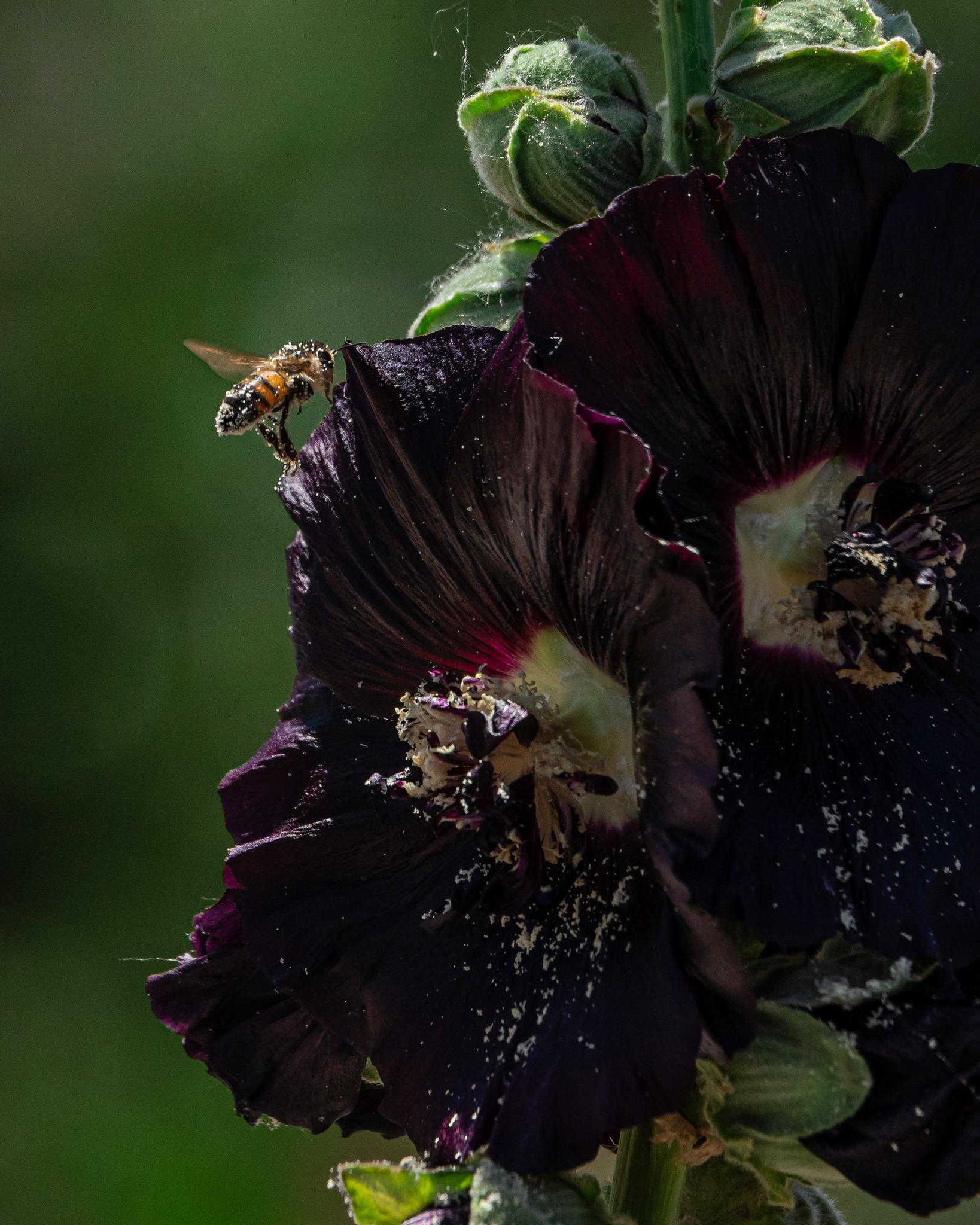
Hollyhocks are a strong example of a plant that combines visual appeal with ecological value. Hollyhocks belong to the mallow family, Malvaceae, and are widely recognized for their tall flower spikes and large, showy blossoms. Their structure makes them easy for people to identify from a distance. That height also places the flowers in view of larger pollinators. Bumble bees often visit hollyhocks because the blooms offer accessible floral resources and because the plants can produce abundant flowers over a long blooming period. Pollinators respond to flower color, scent, reward quality, and bloom architecture. Hollyhocks provide a clear lesson in how plant form influences animal behavior.
From a zoological perspective, a pollinator visit is a feeding event with broader ecological consequences. Bees transfer pollen between flowers as they collect nectar and pollen for their own survival. That movement supports plant reproduction and fruit or seed development. It also sustains food webs. Without pollinators, many wild plants and crop plants would fail to reproduce efficiently. Visitors who notice bumble bees working hollyhocks at the Heritage Farm are seeing an active ecosystem service. The scene shows mutual dependence. The bee gains food. The plant gains reproductive success. Other species benefit later when the plant produces seeds or supports additional insects.
The Heritage Farm setting adds another layer of educational value. Historic farm plantings help visitors see how food production, garden design, and biodiversity can overlap. Hollyhocks have long been associated with farmhouse gardens and rural landscapes in North America and Europe. Their presence often evokes memory and place, which can strengthen interest in conservation. Emotional connection matters in environmental education. People protect what they know and value. When a visitor says a plant reminds them of home, that feeling can become the starting point for deeper learning about plant ancestry, pollinator relationships, and habitat stewardship. The ABQ BioPark Botanic Garden uses that kind of connection well.
The focus on lilies also has strong educational value. The term lily is used broadly in common speech, but the group includes plants with different botanical histories. True lilies belong to the genus Lilium. Water lilies are in a separate family altogether, and calla lilies are not true lilies. Calla lilies, for example, are members of the arum family, Araceae. Their bloom structure is a spathe surrounding a spadix, which differs from the petal arrangement seen in true lilies. That difference gives teachers and gardeners a practical way to explain plant classification. Common names are useful, but scientific names provide precision.
Flower form affects animal interactions. True lilies often present large, open blossoms that can attract a range of insects. Their anthers and stigmas are positioned to contact visiting pollinators. Water lilies grow in aquatic habitats where pollination may involve insects that move across the water surface or visit flowers that open in response to light and temperature. Calla lilies rely on a different floral structure and pollination approach. These differences show how plants adapt to habitat, water availability, and pollinator behavior. A visitor who looks closely at lily flowers can see evolutionary design in action, even without using overly technical language.
Lilies also support public interest because they show wide variation in color, size, and arrangement. That variation reflects both natural diversity and horticultural breeding. Garden collections often include cultivars selected for bloom timing, fragrance, and visual effect. In public gardens, those choices help sustain visitor attention through multiple seasons. They also create opportunities to discuss plant breeding, genetic selection, and the trade-offs involved in cultivating ornamental species. Plant breeding can increase showiness or disease resistance, but it can also reduce genetic diversity if growers rely on a narrow group of parent plants. Botanical institutions can use those facts to explain why diversity matters.
The ABQ BioPark Botanic Garden has had a useful role in showing how ornamental plants connect to broader conservation themes. A garden full of flowering plants can support insects, birds, and other wildlife if it includes a range of native and well-adapted species. Nectar-producing flowers attract bees, butterflies, moths, and some flies. Seed heads can feed birds later in the year. Shrubs and trees provide cover and nesting sites. The structure of a garden matters as much as the species list. Layered plantings create more habitat than a single flat bed of ornamentals. This is a key point in zoo management as well. Habitat design shapes animal welfare, behavior, and breeding success in managed settings.
That connection between gardens and zoos is important. Both institutions educate the public, conserve biological resources, and model responsible stewardship. In zoo management, habitat quality affects stress levels, physical health, and species-specific behavior. In botanical gardens, site design affects plant performance, visitor learning, and wildlife use. Both settings depend on sound environmental planning. They also depend on public support. A photo scavenger hunt may look simple, but it builds that support by helping visitors notice organisms they might otherwise pass by. Awareness is often the first step toward conservation action.
Public gardens also play a role in urban wildlife support. Birds, insects, and small mammals use garden spaces as stepping-stones across developed areas. These patches of habitat help species move, feed, and reproduce in landscapes that might otherwise be too uniform or too dry. In regions with strong seasonal heat, shade trees and irrigated plantings can create small refuges for wildlife. That does not replace native habitat, but it can reduce ecological stress and improve connectivity. In the American Southwest, thoughtful garden management can make a practical difference for local biodiversity.
The educational value of the photo theme is easy to see. A favorite plant or tree invites personal choice, but it also encourages comparison. One visitor may choose a flowering vine. Another may choose a large shade tree. Another may focus on a grass, fern, or aquatic plant. Each choice can lead to discussion about structure, reproduction, and habitat function. Trees offer nesting sites and microclimates. Flowering herbs support insects. Aquatic plants stabilize pond edges and help with water quality. The visible form of a plant often hints at its ecological role. Botanical gardens can use that connection to make science feel concrete.
Pollinators deserve special attention because they connect gardens to wider conservation concerns. Bee populations face pressures from habitat loss, pesticide exposure, disease, parasites, and climate variability. Monarch butterflies and other insects also depend on food plants and seasonal movement corridors. A public garden cannot solve those problems alone, but it can help by providing forage, nesting resources, and education. Visitors who notice bumble bees on hollyhocks or insects on lilies may start to understand that pollinators need more than a single flower bed. They need continuous habitat, safe management, and seasonal resources across a landscape.
The ABQ BioPark Botanic Garden has had success drawing attention to these issues because it presents science in a friendly format. That approach matters for environmental stewardship. People often learn best when they can see, photograph, and talk about what they observe. The social media format increases reach, but the real value is in the behavior it encourages. Visitors slow down. They look at plant details. They notice insects. They ask questions. That process improves environmental literacy. It also supports long-term conservation goals by building a public that understands why gardens and native habitats need care.
There is also a strong cultural dimension to plant choice. Favorite plants often reflect family history, region, and memory. Hollyhocks may bring back images of a farmyard or a childhood garden. Lilies may connect to seasonal traditions, memorial plantings, or a sense of order and beauty. Botanical institutions can use those associations to make plant science accessible without reducing the science itself. A garden becomes more meaningful when it connects personal experience to pollination biology, taxonomy, and ecosystem function. That balance is part of effective public education.
Visitors who share photos also help document bloom timing and seasonal change. While a social media post is not a formal research record, repeated public observations can highlight when plants flower, how long displays last, and which species draw the most attention. That information can guide education programming and garden interpretation. It can also encourage citizen science participation. People who begin with a photo challenge may later join more structured monitoring projects. That pathway matters. Conservation often begins with simple observation and grows into repeated engagement.
The seasonal closure of the scavenger hunt does not end the learning. Public gardens remain open in many forms, and their value continues across the year. Spring bloom, summer pollinator activity, autumn seed production, and winter structure all support education. Trees reveal branching patterns after leaf drop. Grasses show texture and movement in wind. Evergreen plants provide cover and visual continuity. Each season presents a different lesson. The ABQ BioPark Botanic Garden has had a way of turning those lessons into public interest by making observation part of the visitor experience.
A strong botanical garden is both a display and a resource. It supports conservation, education, and community engagement at the same time. It gives people a place to study plants, observe pollinators, and think about habitat care. It also shows how plant collections can support wildlife when they are managed with ecological function in mind. Hollyhocks at Heritage Farm and lilies across the garden are not just decorative features. They are teaching tools. They show how flowers work, how insects feed, and how humans can value living systems through careful attention.
*****
Source Description
The ABQ BioPark Botanic Garden has had so much fun joining the @americanpublicgardens Photo Scavenger Hunt this year. Today is the last day and we’re sad to see it end, but you can come visit us anytime!
From the tallest trees to the smallest ant, we all play a part in the world around us. Public gardens are beautiful spaces to pause and connect as you observe nature coming together all around you.
Today’s theme is: a photo of your favorite plant or tree! Your social media team loves:
• Hollyhocks! “They are hardy, beautiful, and remind me of home. They grow plentifully on my family’s farm where I spent a lot of time growing up. I also love them because they attract and feed many pollinators, especially bumble bees which are one of my favorite animals!” You can see different varieties of hollyhocks blooming now at the Heritage Farm
• Anything with “lily” in the name! “My absolute favorite is the calla lily; though they aren’t true lilies, I just love the unique shape of the blooms. And when you look at the true lilies and water lilies, there is just so much variety in the shapes and colors and they are all gorgeous.” You can find all kinds of lilies throughout the Garden each year!
What’s YOUR favorite plant? Tag us in your photos or Stories, too!
